
Mapping the Self – The Line of the Ball that Rolls
$49.00
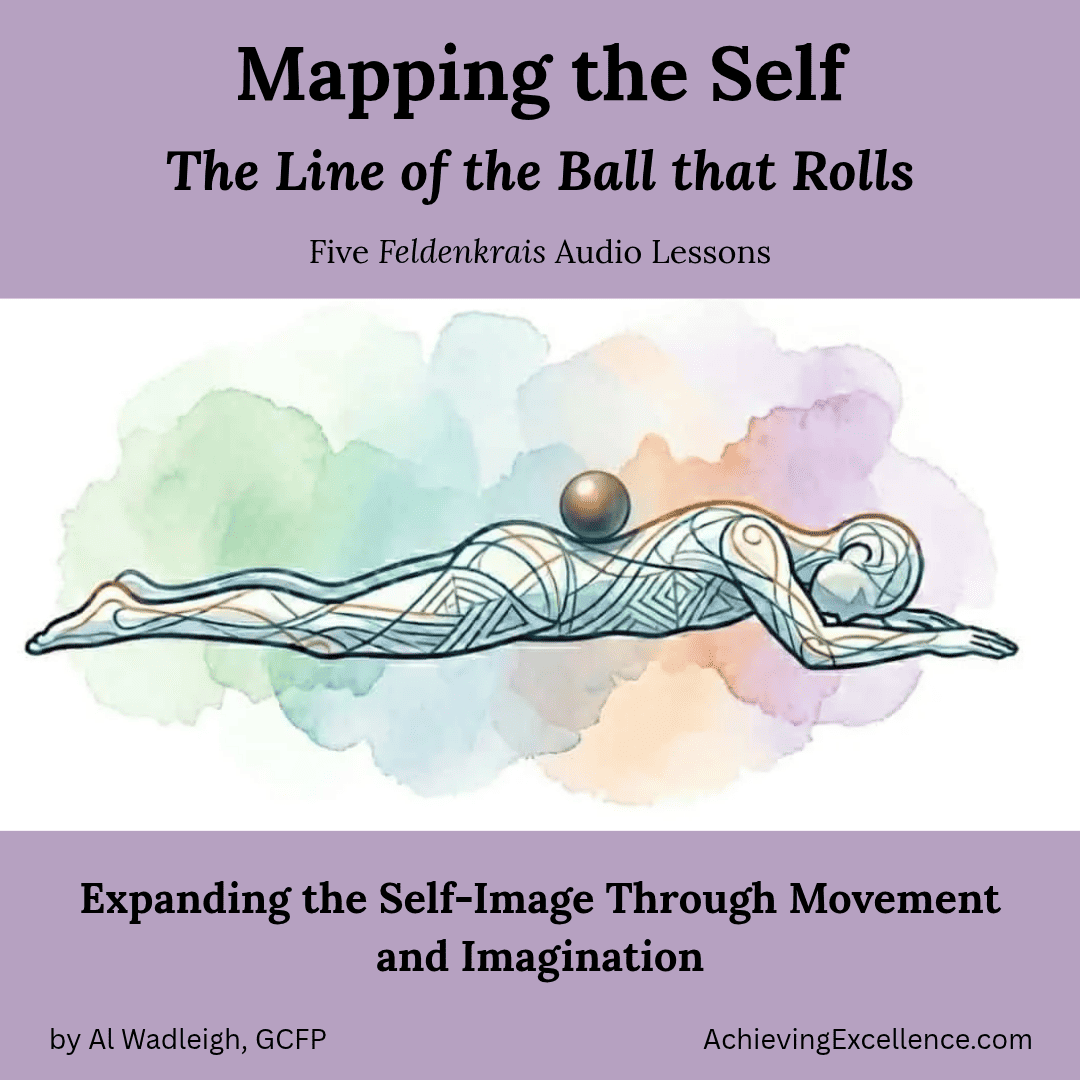
Expand your self-image through movement and imagination. Roll an imaginary ball along your arms, legs, and torso, bringing awareness to parts of yourself you don’t sense as clearly.
By Al Wadleigh, GCFP
5 Feldenkrais audio lessons, MP3 Download or Streaming
Free digital delivery after payment. 7-day refund window. Delivery and refund details.
How much of yourself can you actually feel right now?
Most of us can sense our hands, our feet, and our face. Yet the back of the pelvis, the space between the shoulder blades, and the middle of the chest are much more elusive.
Dr. Feldenkrais believed we act according to our self-image. This means that the parts of ourselves we can sense participate in our movement, and those we can’t sense don’t.
This series of lessons is designed to bring awareness to the parts of us which we are not conscious of, with the help of those of which we are conscious.
In these lessons, you roll an imaginary iron ball over the surface of your arms, legs, and torso. We start with the parts you know well, like the heel, the back of the hand, and the forearm. Then we roll the ball into the parts you don’t sense so clearly: the pelvis, the shoulder blade, the spine, the sternum. By doing so, we awaken the sensory awareness of these parts so they become a part of your self-image.
Listen to the Introduction
The Lessons Include
Lesson 1: The Line of the Ball That Rolls – AY 305 (41:21)
Lesson 2: The Line of Effort in the Stomach and Chest, Part 1 – AY 306 (43:43)
Lesson 3: The Line of Effort in the Stomach and Chest, Part 2 – AY 306 (39:56)
Lesson 4: The Line of Effort Lying on the Back – AY 307 (42:56)
Lesson 5: Roll the Ball Across the Upper Back and Chest – Bonus chair version (33:16)
Total listening time: Approximately 3 hours, 23 minutes, including the introduction and all five lessons.
The Imaginary Ball
The ball is heavy; it obeys gravity, so it rolls slowly and presses in a way that accentuates the solidity of your skeleton. It can’t take shortcuts. To roll it, you have to find a real path through yourself.
Less is more
You’ll keep making the movements smaller and subtler, doing just enough to roll the ball and no more. As the effort drops, the sensation gets clearer. The lessons are gentle, with plenty of rests.
You don’t need to “see” the ball
Some people picture it clearly; others simply sense its weight; others describe the movement. Any way of imagining works. Because any imagined movement engages your brain and nervous system and refines how you move.
What people noticed
After these lessons, participants in the live class reported feeling taller and more balanced, standing and walking with more ease, seeing more clearly, and sensing their surroundings in three dimensions. One described an “effortless turn” while walking.
Who it’s for
Open to anyone curious about movement and imagination; some familiarity with Feldenkrais lessons may help you feel at home with this unusual exploration.
Positions: Floor and chair.
Lesson lineage
These lessons draw on Moshe Feldenkrais’s Alexander Yanai lessons AY 305, AY 306, and AY 307.
Dr. Feldenkrais thought the concepts important enough to include the first lesson, AY 305, in his book Awareness Through Movement as Lesson 11: “Becoming Aware of Parts of Which We Are Not Conscious with the Help of Those of Which We Are Conscious.”
Questions & Answers
Find answers from our store and fellow shoppers.
Be the first to review “Mapping the Self – The Line of the Ball that Rolls”
Related products
-

Interleaving the Arms: Feldenkrais MP3 Series to Awaken Shoulder Freedom & Brain Balance
$39.00 Select options This product has multiple variants. The options may be chosen on the product page -

Bending and Twisting in a Chair
$29.00 Select options This product has multiple variants. The options may be chosen on the product page -

Backward Standing
$19.00 Select options This product has multiple variants. The options may be chosen on the product page -

Skeleton Arms – End Stress and Pain in Your Upper Back
$29.00 Select options This product has multiple variants. The options may be chosen on the product page


Mapping the Self – The Line of the Ball that Rolls
Ratings & reviews
Customer reviews
No reviews found