
Jack Heggie treated skiing as a laboratory for learning. His experiments with ski boots, posture, balance, bumps, and powder show how slowing down and sensing differences can open new possibilities.

Welcome !
Awareness Through Movement® lessons use gentle, exploratory movement and guided attention to create the conditions for learning. These articles explore how sensing yourself more clearly, noticing differences, and experimenting with comfortable variations can support greater ease, coordination, and adaptability in everyday movement.
Jack Heggie treated skiing as a laboratory for learning. His experiments with ski boots, posture, balance, bumps, and powder show how slowing down and sensing differences can open new possibilities.

Al Wadleigh guides nine rounds of Wim Hof–style breathing with differentiated arm, leg, and torso positions. The practice explores the five lung lobes, the two sides of the chest, diaphragm movement, and changes in whole-body awareness.

In this 31-minute Awareness Through Movement lesson, Al Wadleigh explores how the eyes participate in organizing the head, neck, shoulders, spine, pelvis, and whole body during turning. The seated and standing variations use actual and imagined movement to develop clearer differentiation and integration.

Learn to sense into which lung you are breathing more and which lobes are active and which ones are not. Discover how you can use the interplay between breathing, intention, and awareness to direct your breath into your different lobes to access your full potential and level up your breathing practice.

Hopping is about much more than leg strength. In this article, Al Wadleigh explores how Moshe Feldenkrais’s Alexander Yanai hopping lessons reveal hidden habits of effort and improve balance, coordination, breathing, and lightness of movement.

Moshe Feldenkrais taught that movement lessons should improve more than one joint. They can expand the self-image, increase awareness, and help the whole person become more adaptable, integrated, and capable.

Inspired by King Crimson’s 21st Century Schizoid Man, this article explores a surprising connection between progressive rock and the Feldenkrais Method®. Discover how theme, variation, and return form a shared architecture of learning that deepens awareness, improves movement, and transforms the way we learn.

In 2016, Al Wadleigh began a two-year journey through all 550 Alexander Yanai lessons taught by Moshe Feldenkrais. Working through the series in sequence transformed his movement, deepened his understanding of the Feldenkrais Method®, and changed how he approached teaching, Functional Integration®, and learning.

In Alexander Yanai Lesson 399, Moshe Feldenkrais explores the crucial distinction between learning and performing. By doing less than we are capable of doing, we create the conditions for awareness, discovery, and genuine improvement. This simple but profound principle can transform movement, skill development, and the way we approach learning itself.

Alexander Yanai Lesson 305, The Line of the Ball That Rolls, occupies a unique place in the development of the Feldenkrais Method. Taught during the same creative period as Feldenkrais’ lecture on the self-image and later preserved as Lesson 11 in Awareness Through Movement, this remarkable lesson uses movement and imagination to expand body awareness, clarify the self-image, and reveal new possibilities for learning and action.

In Alexander Yanai Lesson 303, Moshe Feldenkrais introduces one of the central ideas of his life’s work: the self-image. Taught while he was writing what would become *Awareness Through Movement* and developing *The Line of the Ball That Rolls* lessons, this remarkable lecture explores the relationship between movement, sensation, feeling, and thought — and how expanding the self-image can expand the person.

This five-minute Feldenkrais Guild UK film offers a view inside a group Awareness Through Movement class. See how participants listen to verbal directions, explore gentle movements at their own pace, use the floor for support and sensory feedback, and reflect on their experiences.
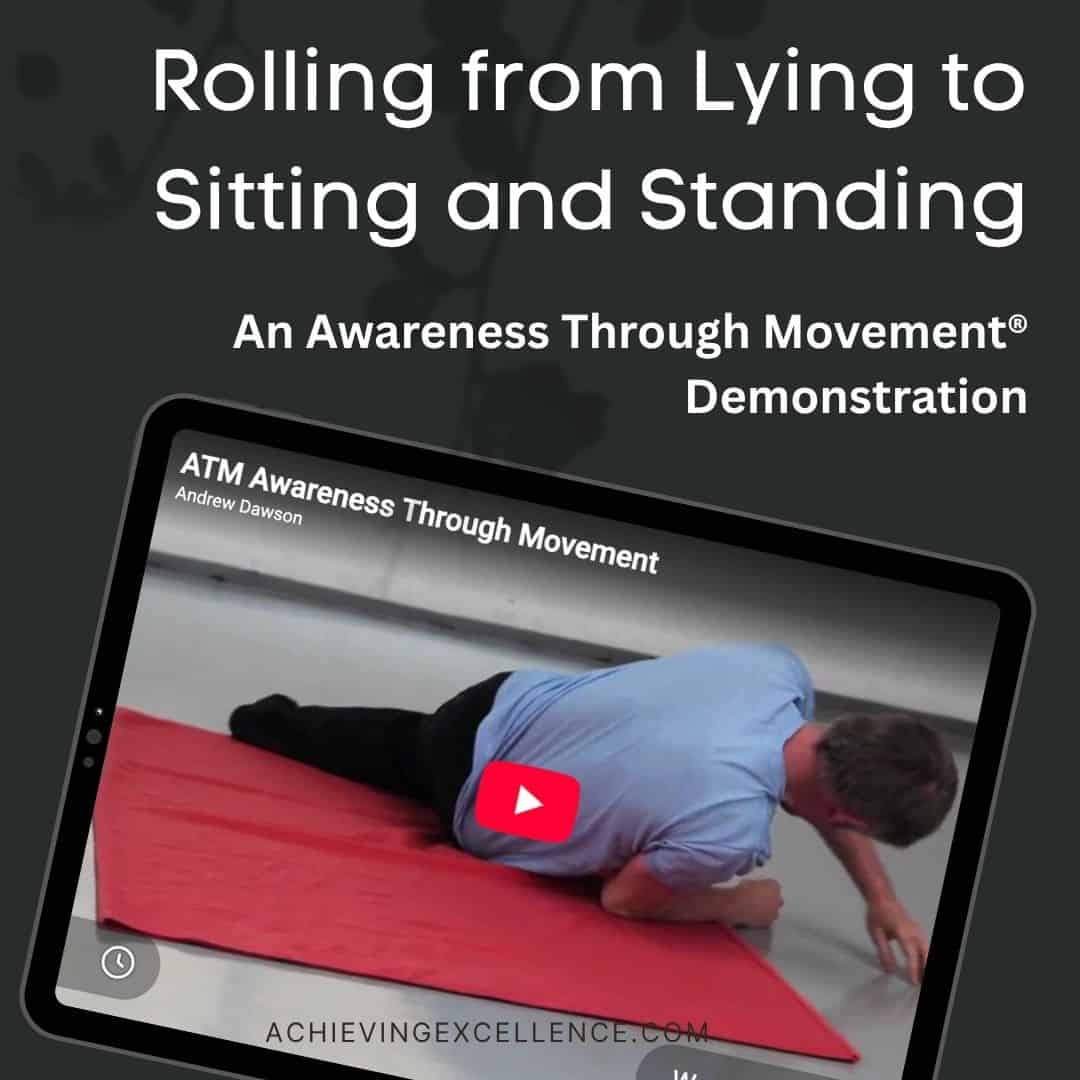
Andrew Dawson demonstrates how a simple sweep of the arm can develop into rolling, sitting, and standing. This short visual companion follows the lesson’s on-screen directions and highlights the continuity of the movement.

In Movement Nature Meant, Ruthy Alon uses movement and poetic imagery to explore how we meet gravity, organize the back, recover primal patterns, and rediscover less habitual possibilities. Watch all four parts with a written companion to each film.

In this short film, Baby Liv discovers rolling through curiosity, repetition, and the support of the floor. Irene Lyon’s narration reveals why developmental movements are foundational to Feldenkrais lessons.
Page [tcb_pagination_current_page] of [tcb_pagination_total_pages]