
October 14
By Al Wadleigh, GCFP
Article Summary
The Line of the Ball That Rolls occupies a unique place in the development of the Feldenkrais Method®. Taught during the same creative period as the AY 303 lecture on the self-image and later preserved as Lesson 11 in Awareness Through Movement, this lesson reveals how deeply Dr. Feldenkrais was exploring the relationship between movement, awareness, imagination, and human development.
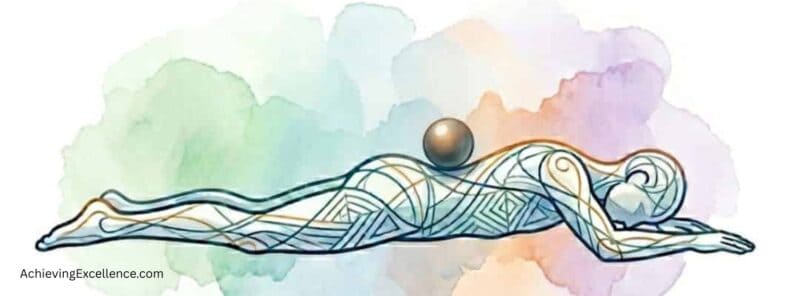
The central idea is deceptively simple: use those parts of ourselves that are clear and familiar to illuminate those parts that remain vague, quiet, or absent from awareness. Through the image of an imaginary iron ball rolling along the limbs, across the diagonals of the body, and eventually through the spine and midline, the nervous system gradually constructs a richer and more complete map of itself.
The lesson demonstrates that imagination is not fantasy. The ball must obey gravity, follow the contours of the body, and move along pathways that are physically possible. In doing so, the imagination becomes anchored in sensation and movement, allowing awareness to become increasingly precise and embodied.
Seen in the context of AY 303 and the chapters on the self-image in Awareness Through Movement, AY 305 becomes much more than an exercise in lifting the head while lying on the stomach. It becomes an exploration of one of Dr. Feldenkrais’ most important insights: that our possibilities are shaped by our self-image, and that by expanding the self-image we expand the person.
The lesson begins with an imaginary ball.
It ends with a larger sense of ourselves.
Introduction
Some lessons stand out in the Feldenkrais corpus not simply because they are elegant or enjoyable, but because they appear at important moments in the development of Dr. Feldenkrais’ thinking. Alexander Yanai Lesson 305 is one of those lessons.
By the time Feldenkrais taught AY 305, he had already begun articulating one of the central ideas of his life’s work: we act according to the image we have of ourselves. This idea appears explicitly in the lecture that became AY 303, The Self-Image, and would later become the opening chapter of Awareness Through Movement, originally titled Improving Abilities.
AY 305 appears to emerge directly from that same creative period.
Feldenkrais thought highly enough of this lesson that he preserved it in published form as Lesson 11 of Awareness Through Movement: Becoming Aware of Parts of Which We Are Not Conscious with the Help of Those of Which We Are Conscious. He also created two additional Alexander Yanai lessons to continue the exploration: AY 306, The Line of Effort in the Stomach and Chest, and AY 307, The Line of Effort in Lying on the Back.
This historical parallel is important. AY 303 presents the philosophy of the self-image. AY 305 begins to show us how that self-image can be expanded.
The lecture is becoming a lesson. The philosophy is becoming an experience. The ideas are becoming embodied.
AY 303 Provides the Philosophy; AY 305 Provides the Experience
In AY 303, Feldenkrais proposes that every person acts according to an image of themselves that has been built gradually over the course of a lifetime. This image includes not only our movements, but also our sensations, feelings, and thoughts.
The self-image is not fixed. It is learned, and because it is learned, it can continue to develop.
The practical question, of course, is how. How do we improve an image that we cannot fully see? How do we discover regions of ourselves that remain outside awareness? How do we enlarge an image whose limitations are themselves invisible?
AY 305 is one of Feldenkrais’ answers to these questions.
Rather than trying to improve movement directly, he begins by improving awareness of ourselves through movement and imagination. The lesson gradually expands the nervous system’s map of the body and, in doing so, expands the self-image itself.
The Published Companion: Awareness Through Movement Lesson 11
The relationship between AY 305 and Lesson 11 of Awareness Through Movement is striking.
The published lesson opens with a discussion of the uneven nature of awareness. Feldenkrais observes that most people are far more aware of their lips and fingertips than they are of the back of the head or the armpits. A complete and uniform self-image, including all parts of the body as well as sensation, feeling, and thought, remains an ideal that few people achieve naturally.
The purpose of the lesson is therefore very clear: to become aware of those parts that remain outside the range of active and conscious use in normal life.
The structure of the two lessons is also remarkably similar.
Both begin with the heel and lower leg. Both move to the hand and arm. Both develop the diagonal pathways through the body. Both define the midline through the spine. Both conclude by asking the student to imagine the front of the body with the same clarity that has been established in the back.
This is not a casual resemblance.
Feldenkrais was clearly developing these ideas as part of a larger project concerning the self-image, awareness, and human development.
Using the Known to Define the Unknown
The central strategy of the lesson is deceptively simple.
Feldenkrais does not begin with the vague parts of ourselves. He begins with the clear ones. Most people can easily sense the heel. Most people can sense the back of the hand. Most people can locate the shin or forearm without difficulty.
These familiar landmarks become starting points for exploration.
From these islands of clarity, awareness gradually moves toward regions that are less defined. The ball approaches the pelvis. It approaches the shoulder blade. It approaches the center of the spine.
Suddenly the certainty disappears, and the path becomes less obvious. The image becomes vague.
These moments are not failures of imagination. They are moments in which the boundaries of the current self-image become visible.
The lesson uses the known to define the unknown. As the unknown becomes clearer, the self-image expands.
The Ball Defines the Self-Image
The imaginary iron ball is one of the most elegant teaching devices in the Feldenkrais Method.
When you accept the reality of the imaginary iron ball, you realize it cannot cheat; it cannot jump over unclear areas. It cannot skip sections of the body that are poorly represented. It cannot pass through empty space simply because we wish it to.
The ball must roll.
This requirement changes everything. Suddenly the nervous system must answer practical questions. Where exactly does the ball pass from the thigh to the pelvis? Where does it cross the waist? How does it travel from the spine to the shoulder blade? Where does it rest on the back of the hand without falling?
The lesson gradually transforms approximation into specificity. The ball defines the current self-image and, in the process, begins to enlarge it.
Imagination Must Obey Gravity
One of the remarkable features of this lesson is that imagination is never allowed to drift into fantasy.
The ball exists within gravity, and gravity provides the rules.
If you do not organize the movement appropriately, the ball falls. If the shoulder rises too quickly, the ball falls. If the pelvis rotates in the wrong direction, the ball falls. If the imagined path is vague, the ball falls.
The nervous system therefore has to organize movement honestly. The lesson asks us to imagine within reality rather than outside of it.
This is one reason the experience often feels surprisingly concrete despite involving an entirely imaginary object. The imagination is anchored to the physical world.
The Diagonals Organize the Whole Person
One of the major discoveries in AY 305 is the importance of diagonal organization. The lesson first develops the pathway from the right heel to the left hand. Later it develops the opposite diagonal from the left heel to the right hand.
These pathways are not arbitrary.
Human locomotion is diagonal. Walking, running, crawling, and rolling are diagonal.
Your movement organizes around relationships between opposite shoulder girdles and opposite sides of the pelvis.
As the ball begins to travel effortlessly between hand and heel, you begin to function less like a collection of separate parts and more like a coherent whole. The nervous system discovers connections that were present all along but had not yet become conscious.
Defining the Midline
The lesson does not stop with the diagonals.
Eventually, Feldenkrais places the ball at the nape of the neck and asks us to roll it downward between the shoulder blades and toward the pelvis.
The question changes. Instead of asking how the ball crosses the body, the lesson begins asking how the ball remains in the center.
The spine gradually emerges as more than a stack of vertebrae. It becomes an organizing axis. The chest participates. The ribs participate. The pelvis participates. The back begins to function as a continuous pathway rather than as disconnected regions.
This portion of the lesson is easy to overlook, but historically it is extremely important. Feldenkrais is not merely teaching movement. He is helping students define the center of themselves.
AY 306 and AY 307 Continue the Exploration
Perhaps the strongest evidence for the importance of this lesson is that Feldenkrais did not stop here.
At the conclusion of Lesson 11 in Awareness Through Movement, he asks the reader to lie on the back and imagine similar pathways that would bring equal clarity to the front of the body.
In the Alexander Yanai series, however, he chooses a different approach. Rather than leaving the idea as an exercise for the reader, he develops two additional lessons.
AY 306 explores the stomach and chest and AY 307 continues the investigation while lying on the back.
Seen from this perspective, AY 305 is not an isolated lesson. It is the beginning of a series devoted to expanding the self-image through movement, imagination, and awareness.
Awareness Before Improvement
Many systems of physical training begin with correction. Stand straighter. Pull the shoulders back. Engage the core. Stretch farther. Work harder.
Feldenkrais takes a very different approach. First we learn to know ourselves more completely. Only then does improvement emerge.
The lesson is not primarily about lifting the head or raising the leg. It is not primarily about strengthening the back. It is not even primarily about improving posture.
The lesson is about improving the quality and completeness of awareness.
As the self-image becomes richer and more detailed, movement frequently reorganizes itself without force or correction.
Expanding the Self-Image
AY 305 quietly demonstrates one of the most optimistic ideas in all of Feldenkrais’ work. The self-image is not fixed. It can continue to develop throughout life.
Parts of ourselves that were previously vague can become clear. Relationships that were absent can become available. Possibilities that once seemed impossible can become natural.
The lesson begins with an imaginary ball rolling along the heel and the back of the hand. By the end, something much larger has changed. The nervous system possesses a richer map. The body possesses more options. The person possesses a larger sense of themselves.
That, perhaps, is the real subject of the lesson. The line of the ball that rolls is ultimately the line along which the self-image expands.
Looking Ahead
Together, AY 303, AY 305, AY 306, and AY 307 capture Feldenkrais during one of the most creative periods of his career.
AY 303 explains why the self-image matters. AY 305 shows how it can begin to change. AY 306 and AY 307 continue the exploration into the front body and the central axis of the self.
Taken together, they reveal the emergence of one of Feldenkrais’ most important insights:
When we expand the self-image, we expand the person.
Experience the Series Yourself
In July of 2026 I taught AY 305, AY 306, and AY 307 as part of a four-week series called Mapping the Self: The Line of the Ball That Rolls.
Together, these lessons explore one of Dr. Feldenkrais’ central ideas: using those parts of ourselves that are clear and familiar to illuminate those parts that remain vague, quiet, or absent from awareness.
Recordings of the complete series will be available in the future as a downloadable audio program for home study and exploration.
Frequently Asked Questions About The Line of the Ball That Rolls and the Feldenkrais Method®
The Line of the Ball That Rolls is an Awareness Through Movement® lesson developed by Dr. Moshe Feldenkrais that uses imagination and movement to improve the body’s internal map of itself. Students imagine an iron ball rolling through the body along specific pathways, helping to clarify relationships between the limbs, spine, pelvis, and shoulders.
The imaginary ball helps define pathways through the body that may be vague or absent from awareness. Because the ball must obey gravity and move along realistic routes, the nervous system begins organizing movement more clearly and efficiently around these newly discovered connections.
The lesson explores diagonal relationships such as the right heel to the left hand and the left heel to the right hand. These diagonal patterns are fundamental to walking, crawling, rolling, running, and many other human movements. Improving awareness of these relationships often improves whole-body coordination and integration.
Dr. Feldenkrais taught that we act according to the image we have of ourselves. The Line of the Ball That Rolls expands that self-image by helping students become aware of areas and relationships in themselves that were previously unclear, disconnected, or absent from awareness.
AY 305 and Lesson 11 of Awareness Through Movement are closely related expressions of the same important idea. Both lessons use clear and familiar parts of ourselves to illuminate less familiar regions and to expand the self-image through movement and imagination.
Tags
alexander yanai, awareness through movement, AY, AY 305, body awareness, diagonal movement, Feldenkrais Method, imagination in movement, midline awareness, Moshe Feldenkrais, Self-Image, somatic learning
