
June 29
Article Summary
How does your connection to the ground affect balance, posture, and movement?
In this classic article, Ralph Strauch explores the relationship between the feet, the nervous system, and our sense of support in gravity. He explains how modern footwear and flat urban environments reduce sensory feedback from the feet, leading many people to rely on unnecessary muscular effort rather than efficient skeletal support.
Through the lens of movement science, Tai Chi, and the Feldenkrais Method®, Strauch shows how reconnecting with the earth beneath our feet can improve balance, coordination, confidence, and overall ease of movement.
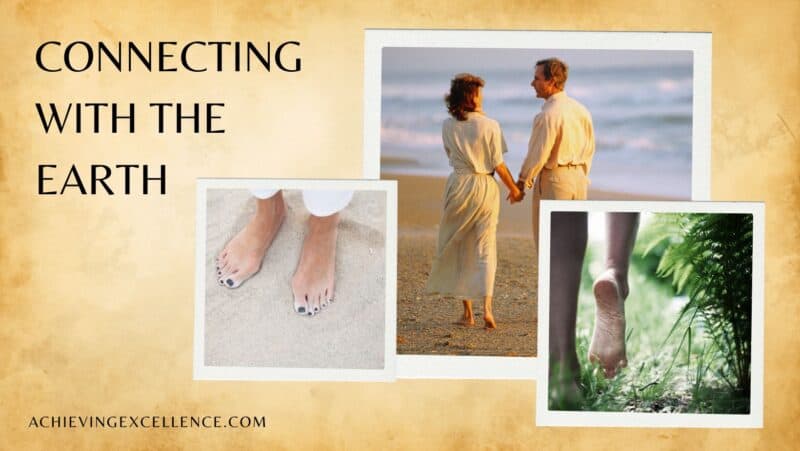
Connecting with the Earth
Human beings and our hominid ancestors have walked upright for more than three million years—mostly barefoot on natural terrain, in an ongoing and intimate relationship with the earth beneath their feet.
That relationship fostered the balance and physical agility—rare in contemporary urban society—that allowed people to walk easily across a log over a stream, even with objects balanced on their heads. It also supported a deep and enduring sense of self, along with a corresponding sense of psychological and even spiritual security.
Comparatively recently, that relationship began to change.
We smoothed the surfaces we walk on: floors, courtyards, and streets. We encased our feet—perhaps first in soft animal skins and eventually in increasingly rigid and restrictive footwear. And we moved from countryside to towns and cities, further reducing our contact with natural terrain.
Many people today live their entire lives without ever stepping barefoot on natural ground, or they do so only in stiff, rigid-soled shoes.
With that change, the intimate contact with the earth that our ancestors experienced has largely disappeared. Along with it, much of our natural grace and agility has faded as well.
Few people today could comfortably walk across a log over a stream, much less do so with something balanced on their heads. More significantly, the deeper sense of self and security that accompanied our connection to the ground beneath us has also diminished.
Anxiety appears in many forms: from aggressive posturing meant to mask insecurity, to persistent background unease, to the barely concealed fears that shape many people’s lives.
Support in the Field of Gravity
The ability to support ourselves upright in gravity is the fundamental base upon which nearly all our activities depend.
Yet we rarely notice gravity or how we respond to it. Its presence is constant and therefore invisible to our attention.
This is normally appropriate. Essential functions such as breathing, digestion, circulation—and support—should occur automatically. Over millions of years we evolved reflex systems that regulate these processes without conscious effort.
Yet modern lifestyles often disrupt these natural reflexes. The result can be stiff chests that limit breathing, digestive disturbances, high blood pressure, and inefficient patterns of support in standing and walking.
Three systems in the body cooperate to maintain support:
- The skeleton
- The musculature
- The nervous system
The skeleton provides the body’s structure. Muscles attach to bones and produce movement through contraction. The nervous system senses both the external world and the internal state of the body, coordinating muscular activity in response.
Ideally, the body’s weight should be transmitted through the skeleton, while muscles organize the bones but carry little weight directly.
When this occurs, movement feels light and fluid. As Chinese Tai Chi masters describe it, the body becomes so sensitive that “a fly alighting upon it would set it in motion.”
Few people experience that kind of lightness today.
Instead, many carry themselves slightly out of balance and use muscular effort to support their weight. Muscles remain chronically contracted simply to maintain posture. As a result, movement becomes stiff and effortful.
Rather than experiencing the clean upward support of the ground through the skeleton, that force is absorbed by unnecessary muscular tension. The sense of connection with the earth is weakened.
Awareness and the Nervous System
The difference between effortless support and effortful support lies largely in how we use our nervous system.
Balanced support requires a continuous awareness of the body’s position in space and the forces acting upon it. Tiny adjustments occur constantly to maintain equilibrium.
Effort-based support, by contrast, depends less on awareness and more on rigidity created by muscular contraction.
Human beings evolved nervous systems capable of finely tuned balance. Sensory receptors throughout the body supply information, while reflex circuits in the brainstem and spinal cord transform that information into coordinated responses.
Why then is balanced support so rare?
Part of the answer lies in the systematic training we receive as children to suppress bodily awareness and to rely on effort instead.
Think back to being six years old.
Even if you could not articulate it, you knew something important: sitting perfectly still is unnatural for a young human being.
Yet children are placed in classrooms and told to sit still, not squirm, not look out the window, and ask permission even to use the bathroom.
The impulse to squirm is the body’s natural feedback trying to regain balance and comfort. But the authority of the classroom overrides that awareness. Over time, external instruction replaces internal perception.
Through countless similar experiences, we gradually lose the awareness that supports balanced movement and connection with the earth.
This perspective is central to the Feldenkrais Method®. Rather than strengthening muscles to improve balance, Feldenkrais lessons help people refine awareness and discover more efficient ways of organizing themselves in gravity. As awareness improves, unnecessary effort often decreases naturally.
The Sensory Intelligence of the Feet
Walking across natural terrain is an ongoing dialogue between your body and the ground beneath it.
Your feet are richly supplied with sensory receptors designed to detect subtle variations in surface angle, texture, firmness, and slope.
When your foot first contacts the ground, these sensors inform your nervous system about the terrain. Reflexes in the spinal cord then organize your legs, pelvis, and spine accordingly before your full weight settles onto the foot.
For example, when walking along a slope that rises to your right, the outer edge of your right foot contacts first. Your nervous system subtly bows the leg inward to accommodate the slope. When stepping onto your left foot, the inside edge touches first and the leg responds in the opposite direction.
These adjustments occur automatically and minimize the effort required for walking.
At least that is how the system evolved to function.
But modern life interferes. Shoes dull the sensitivity of the feet, and flat, uniform surfaces provide little information for the nervous system to interpret.
Over time, the sensory signals fade and the body’s adaptive responses diminish beneath layers of habitual tension.
Imagine what sensitivity your hands would have if you had spent your entire life wearing stiff mittens and only touching large, smooth objects.
The same thing happens to our feet.
A Simple Exploration
Before reading further, stand comfortably. Take a moment to explore your relationship with the ground beneath you.
Notice where you feel pressure on your feet. What is different about how your two feet make contact with the floor? Is there more weight on one heel than the other? Is one arch lifted higher? Is there more weight toward the outside edge of one foot? How is the weight distributed across the bottom of each foot? Is there more weight toward the big toe and small toes?
Now slowly shift your weight left and right. Do you shift your weight more easily over one foot than the other? Do you get taller over one leg than the other?
Now simply stand again. Notice that you feel a little more grounded.
Interestingly, it takes only small movements, combined with awareness, to change how you organize yourself in gravity and help you feel more grounded.
Reconnecting with the Earth
A continuous flow of sensory information from the feet creates a strong sense of connection with the ground beneath us.
With minimal muscular effort, we experience support through the skeleton and a stable sense of grounding. This physical stability contributes to feelings of competence, confidence, and security.
Without that sensory connection, we rely more on muscular effort and feel less supported. Life begins to feel more demanding and less stable.
If this pattern is not obvious in your own experience, observe the people around you. Those who feel least secure often move with the most visible effort and the weakest connection to the ground.
Modern civilization brings undeniable advantages, but it also comes with subtle costs. One of those costs is the dulling of our proprioceptive awareness and the deep sense of connection with the earth that accompanies it.
The encouraging news is that this connection can be restored.
Practices that cultivate awareness of movement—such as Tai Chi, yoga, or the Feldenkrais Method—can help restore this sensitivity. Spending time outdoors on natural terrain can also reawaken the sensory intelligence of the feet.
Perhaps the most important step is simply paying attention. The earth is still beneath your feet, offering support with every step you take. As awareness grows, many people discover greater ease, balance, confidence, and a renewed sense of connection to themselves and the world around them.
Originally written by Ralph Strauch, Ph.D., Certified Feldenkrais Practitioner®. Lightly edited for clarity and web formatting.
Experience Better Balance Through Awareness
The Feldenkrais Method offers a practical way to rediscover the sense of support and grounding described in this article.
Through gentle movement lessons, you can improve balance, posture, coordination, walking, and body awareness while learning to move with greater ease and less effort.
Whether you are looking to improve athletic performance, recover confidence in your movement, or simply feel more comfortable in your body, Feldenkrais lessons provide a powerful path for learning.
👉 Explore a Free Feldenkrais Lesson and experience the difference for yourself.
Frequently Asked Questions About Connecting with the Earth
What does it mean to feel grounded? +
Feeling grounded means sensing clear support from the ground beneath you while maintaining balance, stability, and awareness throughout your body. A strong sense of grounding often contributes to greater confidence, ease of movement, and physical security.
How does the Feldenkrais Method® improve balance? +
The Feldenkrais Method® improves awareness of movement and posture, helping the nervous system organize balance more efficiently. As awareness improves, many people discover they can move with less effort, greater stability, and increased confidence.
Why are the feet important for posture and movement? +
The feet contain thousands of sensory receptors that continuously provide information about the ground. This sensory feedback helps the brain coordinate posture, walking, balance, and the body’s relationship to gravity.
Can awareness improve the way I stand and walk? +
Yes. Increased awareness often reveals unnecessary tension and inefficient habits. As these patterns become clearer, movement can become lighter, more coordinated, and less effortful.
How can I reconnect with the ground beneath my feet? +
Spending time on varied natural terrain, walking barefoot in safe environments, and practicing awareness-based approaches such as the Feldenkrais Method® can help restore your sense of support, balance, and connection with the earth.
Tags
Balance, grounded, grounding, posture, proprioception, Running, walking
