Moshe Feldenkrais at CERN: “Physics and My Method” (1981)
July 26
0 comments

Welcome !
July 26
0 comments
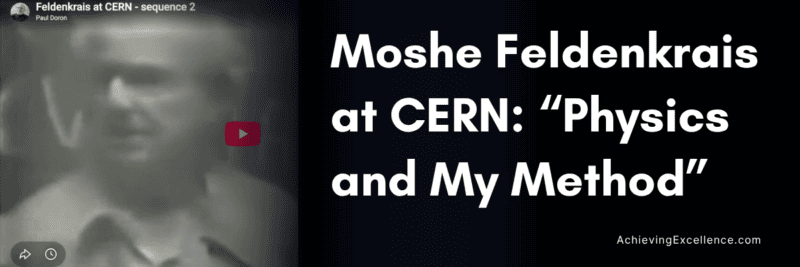
On May 7, 1981, Moshe Feldenkrais spoke at CERN about the relationship between physics, human development, movement, learning, and choice. The four videos below preserve approximately the opening portion of a program that continued into audience questions and a hands-on demonstration. Each video is followed by a written companion, and the final section explains what appears only in CERN’s complete transcript.
On May 7, 1981, Moshe Feldenkrais entered the CERN Auditorium to give a colloquium called “Physics and My Method.” The CERN archival record places the event at 4:30 p.m. and identifies the original source as two cassette recordings later digitized through the CERN Digital Memory project.
The setting mattered. Feldenkrais had studied physics in Paris and worked in the scientific world before becoming known for the Feldenkrais Method® of somatic education. The moderator introduces him through that earlier history: his associations with Frédéric Joliot-Curie, Paul Langevin, and Lew Kowarski; his work in experimental physics; and his later attention to neurophysiology, movement, and learning.
Feldenkrais does not present a conventional account of a technique. He begins with physics in its broadest sense—with the conditions that make observation and action possible—and gradually brings the observer inside the system. Light and vision, the newborn child and the surrounding culture, the skeleton and muscles, intention and action all become parts of one question: How does a human being learn to function in the world?
There is a small archival inconsistency worth preserving. CERN’s catalogue describes the event as a colloquium titled “Physics and My Method,” while the title page of the later transcript calls it a “Presentation at the Microprocessor Conference.” Both descriptions belong to the surviving record; the CERN catalogue supplies the date, place, and archival context.
The four YouTube uploads below were posted by Paul Doron in 2014. They are excerpts from the longer event, not four separate lectures. The YouTube pages do not provide subtitles, so the companions explain the argument without pretending to replace reviewed captions or the complete transcript.
After the moderator’s introduction, Feldenkrais warns that he is asking the audience to consider a different way of looking at the world. He starts with a deceptively simple thought experiment: If there were no light, would animals have eyes? His point is that an organism cannot be understood in isolation from the environment in which its capacities develop.
From there, he turns to the unusually long apprenticeship of a human child. Many animals acquire species-typical behavior quickly. Human beings arrive with a far greater dependence on learning: language, upright movement, social timing, and culturally specific behavior must all be developed through experience. The same biological possibility can therefore produce thousands of languages and many different ways of acting.
Feldenkrais distinguishes this formative learning from the later acquisition of information. Early learning contributes to the person one becomes. It takes place through trial, sensation, movement, imitation, and the particular circumstances of a life. He then broadens the example of locomotion—from walking and riding to wheels, boats, skis, and other inventions—to show that mature human ability depends upon discovering several ways to accomplish an intention.
Near the end of the excerpt, Feldenkrais says that most people use only a small part of their inborn ability. That numerical claim is his own statement in the lecture, not a research finding established by this page. The more useful thread is the one he continues through the rest of the program: human capacity remains closely tied to learning, and learning remains open wherever new distinctions and alternatives can be found.
Part 2 begins as Feldenkrais makes human dependence on environment concrete. A baby cries in the auditorium. He walks toward the child, briefly speaks French, makes the audience laugh, and then returns to his argument. The interruption becomes part of the lecture because a baby learning to speak is precisely the kind of event he is describing: muscles, skeleton, nervous system, senses, other people, and culture participate together.
He uses the learned meaning of time as another example. A six-month-old child does not understand being early or late. Clocks, minutes, weeks, and punctuality belong to a social world that the child gradually enters. Feldenkrais adds gravity, family, society, and culture to the conditions through which a person learns to act.
The discussion then turns to a musician who can no longer play after an injury. Even if bones, muscles, and nerves are treated separately, Feldenkrais argues, the central human difficulty may remain: this person built a life around hearing, timing, skilled differentiation, and musical intention. Playing cannot be reduced to possessing an intact arm. It is an organized ability learned over years in relation to an instrument, a musical culture, and a desired sound.
This is where he names a Functional Integration® lesson as a way of approaching the person’s whole learned organization. He then recounts the case of a Jerusalem Orchestra flutist named Tel-Oren, whose return to playing after a severe arm injury he attributes to work with Feldenkrais and his assistants. The story is historically interesting and central to his explanation, but it remains Feldenkrais’s personal account in the recording; this article does not independently verify its medical details or outcome.
Feldenkrais now asks what a nervous system is for. A person usually becomes aware of it only when something goes wrong, yet it continually connects sensing, intention, and action. It enables an organism to learn about the environment and itself while carrying out what it intends to do.
He identifies movement as the most general basis of action. Breathing, eating, avoiding danger, reproducing, orienting, and maintaining oneself all require movement in some form. In this account, movement matters because it is the observable means through which a living system meets its conditions.
“The most important cue to life is action, movement.”
— Moshe Feldenkrais
The argument then shifts from movement to error. A child does not learn to stand or a beginner learn to ride a bicycle by executing a perfect answer from the start. Each attempt supplies information. Some differences lead toward the intended result; others must be detected and adjusted.
“Learning without errors is not learning; it’s imitation of somebody.”
— Moshe Feldenkrais
Feldenkrais returns to standing, orientation, and the early experiences through which a child develops. People raised in the same family may share much of their biological inheritance while acquiring different ways of acting. Their histories of sensation, relationship, success, error, and correction are not identical. What appears in adulthood as a fixed personal trait may therefore include solutions learned so early and so thoroughly that they now feel compulsory.
The shortest video brings the lecture’s argument to choice. If a person can act in only one way, Feldenkrais calls that action compulsive. A simple yes-or-no alternative gives two possibilities, but he insists that mature human choice requires a third way—enough variation to compare, deliberate, and select.
“Human learning in itself is that they have the ability of doing the same thing in at least three different ways.”
— Moshe Feldenkrais
The claim joins several earlier themes. The nervous system supports intention; learning depends upon detecting differences; and error becomes useful when another possibility can be tried. Choice, in this sense, is a functional capacity rather than a declaration of will.
The formal lecture then gives way to questions. The first audience member asks Feldenkrais to elaborate on the idea of three choices. He answers that speaking or remaining silent, moving or not moving, supplies an on-off distinction available throughout animal life. Human inquiry begins to widen when more alternatives can be conceived and tested. The video ends near the beginning of that exchange, while the official transcript continues for almost another fifty minutes.
The four videos preserve only the opening portion of the CERN event. The complete 47-page transcript, finished by its editors in April 2018, continues to approximately 1:39:26. The following account summarizes that later material; it does not reproduce the transcript.
Feldenkrais extends his discussion of choice through examples involving relationships and scientific research. At CERN, he observes, inquiry would be impossible if a scientist could imagine only one procedure or one interpretation. A plan becomes meaningful because it can be compared with alternatives and revised.
Another question proposes a division between experiential “right-brain” learning and intellectual “left-brain” learning. Feldenkrais answers by emphasizing coordinated action: whatever activity begins in different regions of the brain must ultimately be expressed through the one muscular system available to the person. He also discusses the body’s anatomical asymmetry and its capacity to produce remarkably balanced action.
A later question asks how one person can help another learn. Feldenkrais begins with the newborn child and the mother’s touch, then describes helpful contact as a relationship in which the other person is attended to without being forced into a predetermined correction. This passage gives additional context to the hands-on work he is about to demonstrate.
At approximately 1:16:11 in the transcript, Feldenkrais invites a woman from the audience who is described as having whiplash to sit in front of the group. The transcript records a live Functional Integration demonstration lasting through the end of the event.
He first observes how she sits, the different organization of her legs and shoulders, and how far she can comfortably turn her head. He asks her to remain within movement that does not produce pain. During the demonstration he works quietly, then explains how touch gives him information about breathing, muscular tone, weight, and the person’s response.
The woman subsequently stands and turns while he coordinates movements of her knees, chest, head, and eyes. The audience responds with laughter and applause as he points to changes he observes in her turning. Feldenkrais makes immediate and consequential claims about the woman’s condition during this demonstration. Those statements belong to his 1981 presentation.
The demonstration clarifies his central argument. He is trying to show the CERN audience that a person’s action emerges from an organized whole: sensation, intention, muscular activity, prior learning, and the immediate environment. His method, as presented here, looks for conditions under which the person can detect and enact a different organization.
Feldenkrais begins by asking physicists to consider the conditions that produce an observer. He ends by placing observation inside a living interaction. The teacher observes the student; the student senses differences within herself; each action changes what can be observed next.
That movement from detached explanation to embodied demonstration is what holds the long CERN program together. Light cannot be separated from vision, language from culture, skilled action from personal history, or choice from the availability of alternatives. In “Physics and My Method,” Moshe Feldenkrais asks his scientific audience to treat learning itself as part of the system under investigation.
For the complete event—including the extended questions and the hands-on demonstration—read CERN’s full “Physics and My Method” transcript (PDF). The PDF is the fuller textual source; these companions are an editorial guide to the four excerpts and do not provide equivalent access to every spoken passage.
Source and rights note: The four videos are embedded from Paul Doron’s YouTube channel. The event recording and transcript are credited and linked to CERN; this page does not independently host CERN’s audio, reproduce the complete transcript, or imply ownership of the source media.
Feldenkrais connected physics with questions about human development, movement, learning, and choice. He argued that action cannot be understood apart from the environment, senses, personal history, and learned organization that make it possible.
CERN’s archival record dates the colloquium to May 7, 1981, at 4:30 p.m. in the CERN Auditorium in Geneva. The archive titles the event “Physics and My Method.”
The four YouTube videos do not contain the entire program. The uploads preserve approximately the opening portion of a program whose official transcript continues to about 1:39:26, including a longer question period and a hands-on demonstration.
He treats movement as the means through which intention meets the environment and produces information. Learning develops as a person senses differences, discovers errors, and acquires enough alternatives to choose among several possible actions.
CERN provides a 47-page PDF of the complete event through its Document Server. The transcript includes the material heard in the four excerpts as well as the later audience discussion and demonstration.
Tags
CERN, Feldenkrais Method, Functional Integration, Human Learning, Moshe Feldenkrais, movement education, Physics and My Method
More Videos for You

Relieve Tension in Your Neck and Shoulders with Feldenkrais Exercises